Energy efficiency with solar, storage & EV in Benelux 2026

Rising energy costs push Benelux homeowners and small businesses to seek practical solutions that reduce bills and environmental impact. Combining solar PV, battery storage, and EV charging creates a powerful system that cuts grid dependence and maximizes savings. This guide walks you through preparation, installation, and optimization of integrated energy improvements that deliver measurable results. You’ll learn how to assess your needs, choose the right technologies, and maintain peak performance for years to come.
Table of Contents
Preparing For Energy Efficiency Improvements In Benelux Homes And Businesses
Installing And Integrating Solar PV, Battery Storage, And EV Charging Systems
Maximizing Benefits And Ensuring System Optimization Over Time
Comparison Of Energy Efficiency Improvement Approaches For Benelux Properties
Explore Expert Solutions For Your Energy Efficiency Improvements
Key takeaways
Point | Details |
Increased self-consumption | Integrating technologies can boost solar self-consumption to up to 90%, drastically lowering grid reliance. |
Smart charging savings | Dynamic tariffs and smart EV charging reduce charging costs by up to 20%. |
Financial support available | Benelux subsidies and financing options help offset upfront investment costs. |
Grid stability benefits | Technology integration enhances grid stability and reduces peak demand. |
Charger selection matters | Careful EV charger choice matches vehicle needs and maximizes savings. |
Preparing for energy efficiency improvements in Benelux homes and businesses
Before installing solar PV, battery storage, or EV chargers, you need to understand your energy landscape. Start by reviewing your electricity bills from the past 12 months. Identify your average daily consumption, peak usage times, and seasonal variations. This data reveals whether you consume more energy during mornings, evenings, or weekends, which directly impacts system sizing.
Next, familiarize yourself with the core technologies. Solar PV panels convert sunlight into electricity, typically generating 250-400 watts per panel. Battery storage systems capture excess solar energy for use when the sun isn’t shining, preventing waste and reducing grid purchases. EV chargers come in various speeds and smart capabilities, from basic 3.7 kW units to advanced 22 kW models with dynamic load management. Understanding these basics helps you make informed decisions.
Various subsidies and financing options in the Benelux region help reduce upfront investment costs for energy improvements. Research national and regional programs that apply to your property type. Belgium offers tax deductions for solar installations, while the Netherlands provides subsidies for battery storage through programs like ISDE. Luxembourg has grants for EV chargers and renewable energy systems. Combining these incentives can cut your total investment by 20-40%.
Plan your system size based on realistic energy needs and EV charging habits. A typical Benelux household uses 3,500-4,500 kWh annually, requiring a 4-6 kW solar array. If you drive an electric vehicle 15,000 km per year, add another 2,500-3,000 kWh to your annual consumption. Battery capacity should cover your evening and overnight usage, typically 8-16 kWh for residential properties. Small businesses need larger systems, often 10-25 kW solar with 20-40 kWh storage.
Consult professionals for site assessment and system design. A qualified installer evaluates your roof orientation, shading, structural capacity, and electrical infrastructure. They’ll identify optimal panel placement, inverter sizing, and battery location. Professional design ensures your system operates safely and efficiently, avoiding costly mistakes like undersized inverters or incompatible components. Request multiple quotes to compare approaches and pricing, and verify installers hold relevant certifications for your region.
Key preparation steps include:
Analyze 12 months of energy bills to establish baseline consumption patterns
Research energy subsidies in Benelux that apply to your property type
Calculate total energy needs including current usage plus future EV charging
Obtain professional site assessments from certified installers
Compare custom energy solutions explained to find the best fit
Installing and integrating solar PV, battery storage, and EV charging systems
With preparation complete, here’s how to execute your energy efficiency improvements effectively. Installation follows a logical sequence that builds each component on the previous one, creating a cohesive system.
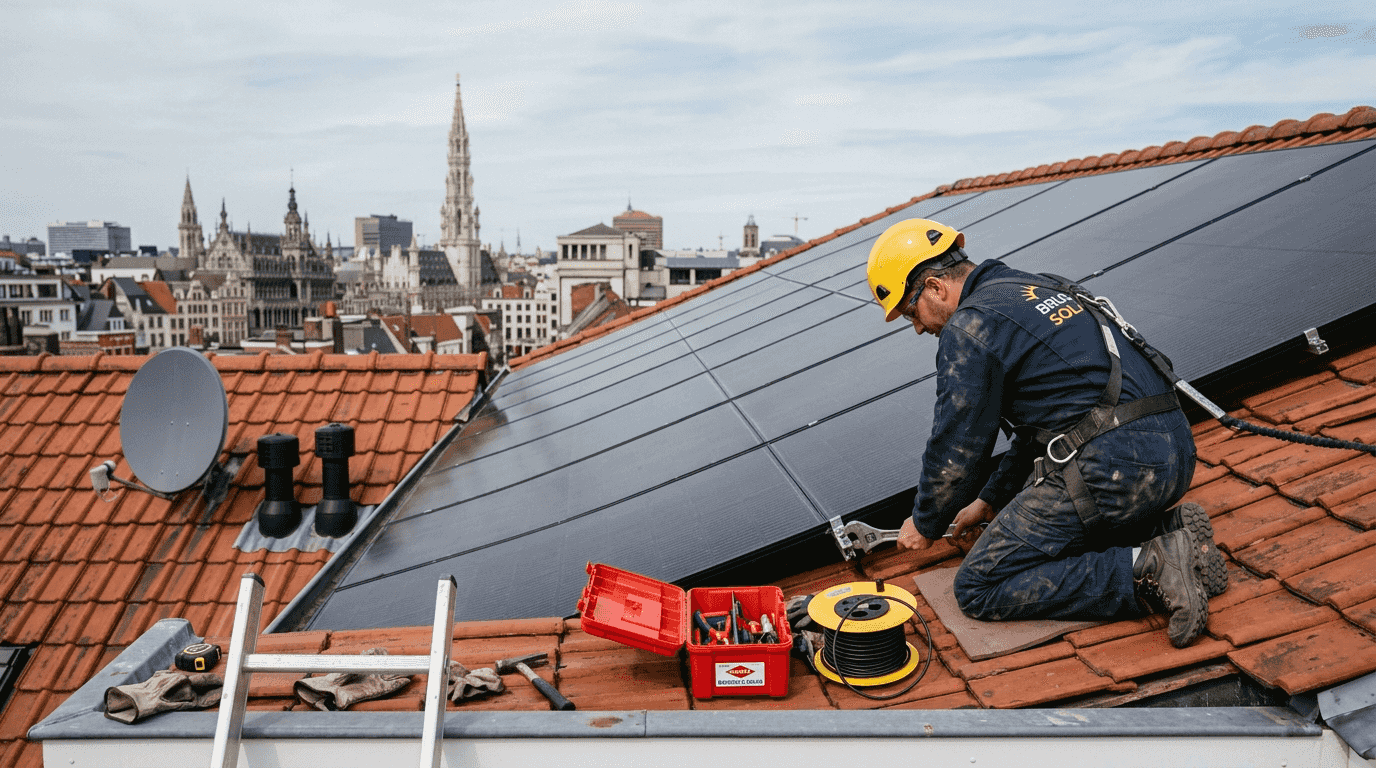
Step 1: Install solar PV panels optimized for your roof and energy needs. Your installer mounts panels on south-facing roof sections with minimal shading, typically at a 30-40 degree angle for Benelux latitudes. They connect panels in strings to an inverter that converts DC electricity to AC power your home can use. The inverter size matches your panel array, usually with 10-20% overhead capacity. Most residential installations take one to two days, with electrical inspection following within a week.
Step 2: Add battery storage sized to store excess solar energy and cover peak demand. Battery placement requires a temperature-controlled location, often a garage, utility room, or basement. The installer connects the battery to your inverter or installs a hybrid inverter that manages both solar and storage. Capacity should match your evening consumption, typically 8-16 kWh for homes. Integrating solar with storage requires careful electrical design to ensure safe operation and maximize self-consumption.
Step 3: Choose an EV charger with smart charging functionalities matching your EV’s capabilities. EV charger choice should consider the vehicle’s charging capabilities and include smart charging to optimize cost savings. A 7.4 kW charger suits most single-vehicle households, while 11-22 kW units serve multiple EVs or faster charging needs. Smart features include scheduling, load balancing, and dynamic tariff response. Mount the charger near your parking spot with dedicated electrical protection.
Step 4: Integrate systems into a smart energy management platform to optimize usage. Modern energy management systems monitor solar production, battery state, EV charging, and household consumption in real time. They automatically route excess solar to batteries or EV charging, preventing grid export when it’s financially disadvantageous. The platform learns your patterns and adjusts operation to minimize costs. Most systems offer mobile apps for remote monitoring and control.
Step 5: Configure smart charging schedules to leverage dynamic off-peak energy tariffs. Set your EV to charge during cheapest hours, typically 23:00 to 07:00 in Benelux markets. The system prioritizes solar energy when available, then battery power, and finally grid electricity during low-rate periods. This three-tier approach minimizes charging costs while ensuring your vehicle is ready each morning. Advanced systems adjust charging speed based on next-day solar forecasts.
Pro Tip: Install a separate meter for your EV charger if your utility offers special EV electricity rates. Some Benelux providers offer rates 30-50% lower than standard residential tariffs for dedicated EV circuits, dramatically improving payback times.
Follow the solar plus storage integration guide for detailed technical specifications and wiring diagrams. Proper integration ensures all components communicate effectively, maximizing system efficiency and longevity. Your installer should provide comprehensive commissioning that tests every function before final handover.
Maximizing benefits and ensuring system optimization over time
After installation, ongoing optimization ensures you maximize savings and system lifespan. Active management separates good systems from great ones, often doubling financial returns over 20 years.
Monitor energy production and consumption with smart meters regularly. Check your system dashboard weekly to verify solar generation matches expectations for the season. Compare actual battery cycles to projected usage, ensuring the system charges and discharges as programmed. Most platforms highlight anomalies like unexpected grid consumption or reduced solar output, prompting investigation before small issues become expensive problems.
Adjust EV charging and battery use based on real-time tariffs and solar availability. When dynamic pricing signals low rates, increase battery charging from the grid to capture cheap energy. During high-rate periods, rely exclusively on solar and battery power. Your EV charging schedule should flex with both tariffs and your driving schedule, ensuring full charge when needed while minimizing costs. Some systems automate these adjustments using API connections to energy markets.
Schedule maintenance checks for batteries and chargers to ensure efficiency. Annual inspections should verify electrical connections remain tight, cooling systems function properly, and software stays updated. Battery management systems need firmware updates that improve performance and add features. EV chargers require periodic testing of ground fault protection and load balancing functions. Professional maintenance typically costs €150-300 annually but prevents failures that cost thousands.
Integrated systems can boost solar self-consumption from 30-40% to 70-90%, reducing grid reliance. Without storage, excess solar energy exports to the grid at low compensation rates. Adding batteries captures this energy for evening use, when grid electricity costs peak. EV charging during solar production hours further increases self-consumption, especially for daytime home workers or businesses. The result is dramatically lower electricity bills and faster system payback.
Contribute to grid stability through reduced peak demand and ancillary services. Virtual Power Plants aggregating batteries and EVs enhance grid stability and reduce peak demand. Your system can participate in demand response programs that pay you to reduce consumption during grid stress. Some utilities offer capacity payments for battery systems that can discharge to the grid during emergencies. These revenue streams add 5-15% to your annual savings while supporting renewable energy integration.
Peter van Hees’s smart energy management system significantly lowered his energy bills through intelligent integration of solar, storage, and EV charging. His Brussels home demonstrates how coordinated technology management delivers results beyond simple component addition. By treating his property as an energy ecosystem rather than isolated systems, he achieved near energy independence.
Pro Tip: Set up automated alerts for system performance metrics like daily solar production below seasonal averages or battery capacity degradation exceeding 1% annually. Early detection of issues prevents cascading failures and maintains optimal performance.
Key optimization practices include:
Review system performance metrics weekly using mobile apps or web dashboards
Update charging schedules seasonally to match changing solar production patterns
Participate in grid-connected battery storage programs for additional revenue
Implement smart home energy management to coordinate all loads
Document all maintenance and performance data for warranty claims and system optimization
Metric | Without Integration | With Full Integration | Improvement |
Solar self-consumption | 30-40% | 70-90% | +100-125% |
Annual grid purchases | 3,200 kWh | 800 kWh | -75% |
EV charging cost per kWh | €0.25 | €0.20 | -20% |
Payback period | 12-15 years | 8-10 years | -33% |
Grid peak demand contribution | 100% | 25% | -75% |
Comparison of energy efficiency improvement approaches for Benelux properties
To help you decide, here’s a side-by-side comparison of popular energy efficiency improvement setups. Each configuration offers different benefits, costs, and complexity levels suited to various property types and budgets.
Solar PV alone offers modest grid independence but limited savings. You generate clean electricity during sunny hours, reducing daytime grid consumption by 30-40%. However, excess production exports to the grid at rates often 50-70% below retail electricity prices. Without storage, evening consumption still relies entirely on grid power at peak rates. This approach suits budget-conscious homeowners who want to start small, with typical costs of €5,000-8,000 for a 4-6 kW system.
Adding battery storage increases self-consumption and backup power. Storage captures excess solar energy for evening use, boosting self-consumption to 60-75%. You gain energy security during grid outages and reduce reliance on expensive peak-hour electricity. However, batteries add €6,000-10,000 to system costs, extending payback periods. This configuration works best for properties with high evening consumption or unreliable grid service.
Incorporating an EV charger with smart features optimizes overall energy use. Integrating solar PV with battery storage and EV charging yields higher self-consumption and cost savings than solar PV alone. Smart chargers prioritize solar energy, then battery power, then cheap grid electricity, minimizing charging costs while maintaining convenience. Full integration pushes self-consumption above 85%, with total system costs of €15,000-25,000 depending on capacity.
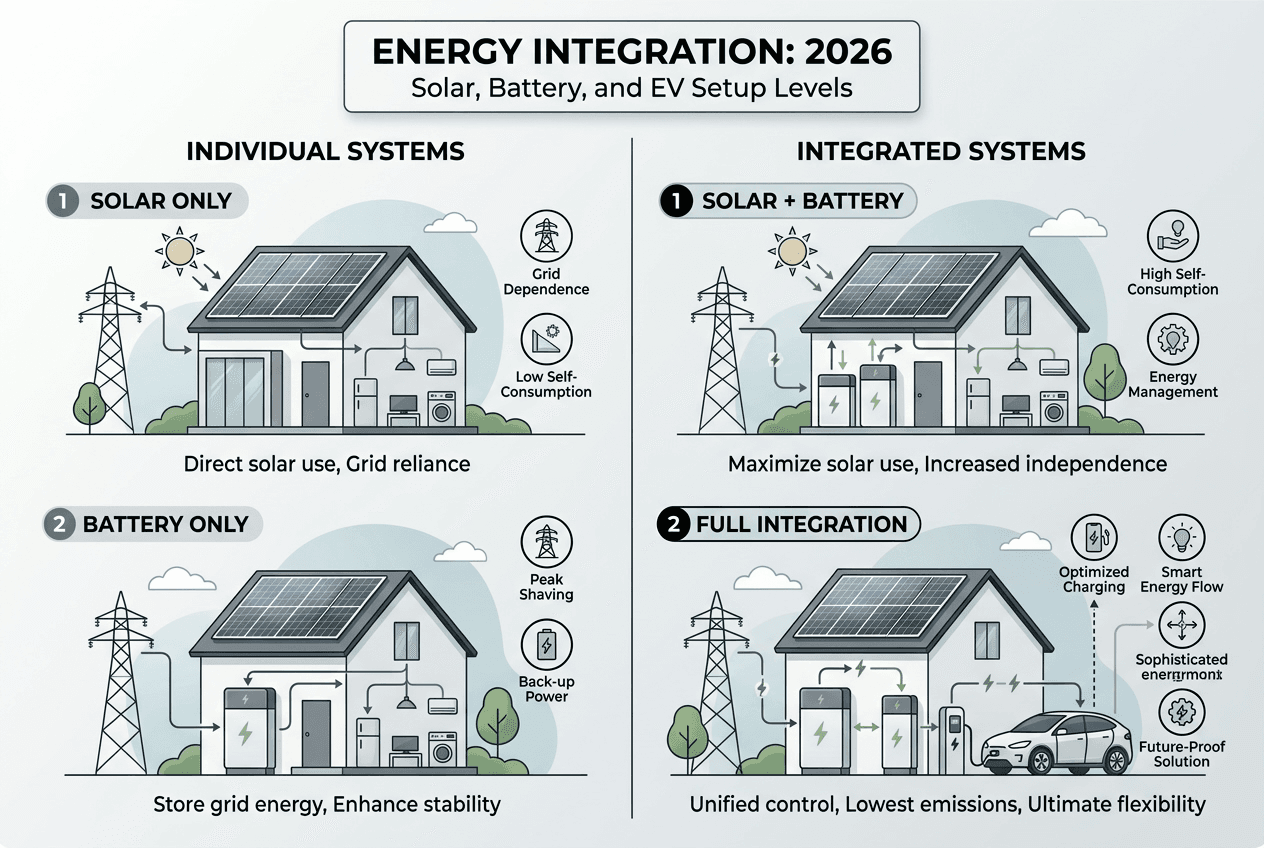
Costs and complexity increase with integration but offer better long-term returns. A fully integrated system requires coordinated installation, sophisticated energy management software, and ongoing optimization. Initial investment runs 2-3 times higher than solar alone. However, annual savings increase proportionally, often reaching €1,500-2,500 for typical households with EVs. Payback periods remain competitive at 8-12 years, with 25-year savings exceeding €30,000.
Selection depends on property size, energy use, EV ownership, and budget. Small apartments with limited roof space suit basic solar installations. Family homes with EVs benefit most from full integration. Businesses with daytime energy consumption can maximize solar value without storage. Evaluate your specific situation using the comparison below.
Configuration | Self-Consumption | Annual Savings | Initial Cost | Payback Period | Best For |
Solar PV only | 30-40% | €400-600 | €5,000-8,000 | 12-15 years | Budget-conscious, low evening use |
Solar + Battery | 60-75% | €800-1,200 | €11,000-18,000 | 10-13 years | High evening consumption |
Solar + EV Charger | 50-60% | €900-1,400 | €8,000-12,000 | 9-12 years | EV owners, daytime charging |
Full Integration | 85-90% | €1,500-2,500 | €15,000-25,000 | 8-10 years | EV owners, energy independence |
Key decision factors:
Current annual electricity consumption and cost
EV ownership and daily driving distance
Available roof space and orientation
Budget for upfront investment
Access to energy subsidies in Benelux
Explore PV and storage benefits to understand how combined systems outperform individual components. The synergy between technologies creates value that exceeds simple addition, making integrated approaches increasingly popular across Benelux markets. Review benefits of solar PV as a foundation for understanding how each component contributes to overall system performance.
Explore expert solutions for your energy efficiency improvements
Ready to transform your property’s energy profile? Belinus offers expert guidance and customized plans for energy efficiency upgrades across the Benelux region. Our integrated approach combines solar PV, battery storage, and EV charging into cohesive systems that maximize savings and minimize complexity. We handle everything from initial assessment through installation and ongoing optimization.

Discover financing help, product recommendations, and professional installation services tailored to your specific needs. Our team evaluates your property, energy patterns, and goals to design solutions that deliver measurable results. Visit Belinus to start your journey toward lower energy costs and a greener footprint. Our 25-year financial modeling tools show exactly what to expect from your investment, removing guesswork from your decision.
FAQ
How much can I save on energy bills by combining solar PV, battery storage, and EV charging?
Savings vary based on your consumption patterns, system size, and local electricity rates, but integrated systems can boost solar self-consumption to 70-90% and reduce charging costs by up to 20%, significantly lowering energy bills. Typical Benelux households with EVs save €1,500-2,500 annually compared to grid-only electricity. Businesses often see higher absolute savings due to larger systems and daytime consumption that matches solar production. Subsidies further improve payback times, often reducing them to 8-10 years.
What subsidies and financing options are available for these improvements in Benelux?
Various regional subsidies and financing programs help reduce upfront costs for solar PV, battery storage, and EV chargers in Benelux. Belgium offers tax deductions up to 30% for solar installations and reduced VAT rates for battery systems. The Netherlands provides ISDE subsidies for storage and EV chargers, covering 15-25% of costs. Luxembourg grants support renewable energy through direct subsidies and favorable loan programs. Check local government and utility websites for current incentives, as programs update annually. Combining multiple incentives can reduce total investment by 30-50%.
How do smart charging and dynamic tariffs reduce EV charging costs?
Smart chargers schedule charging to times when electricity is cheapest, typically overnight hours when grid demand drops. Smart charging with dynamic energy tariffs saves EV owners up to 20% by timing charging during off-peak hours. Dynamic tariffs reflect real-time grid conditions, rewarding off-peak consumption with rates 40-60% below peak prices. Your system automatically shifts charging to these windows, reducing overall EV charging expenses without inconveniencing you. Advanced systems also prioritize free solar energy when available, further cutting costs.
Can integrating these technologies enhance grid stability in Benelux?
Yes, integrated home systems can act as virtual power plants supporting the grid during peak demand periods. Aggregated residential batteries and EVs provide grid services like frequency regulation, improving stability and reducing peak power plant use. They help balance supply and demand, especially during peak times when renewable generation fluctuates. This reduces strain on traditional power plants and fosters cleaner energy use across the network. Some utilities compensate participants through capacity payments or reduced electricity rates, creating additional value beyond direct bill savings.
Recommended
Comments