Graphene Supercaps: 200 Wh/L Energy Density in 2026
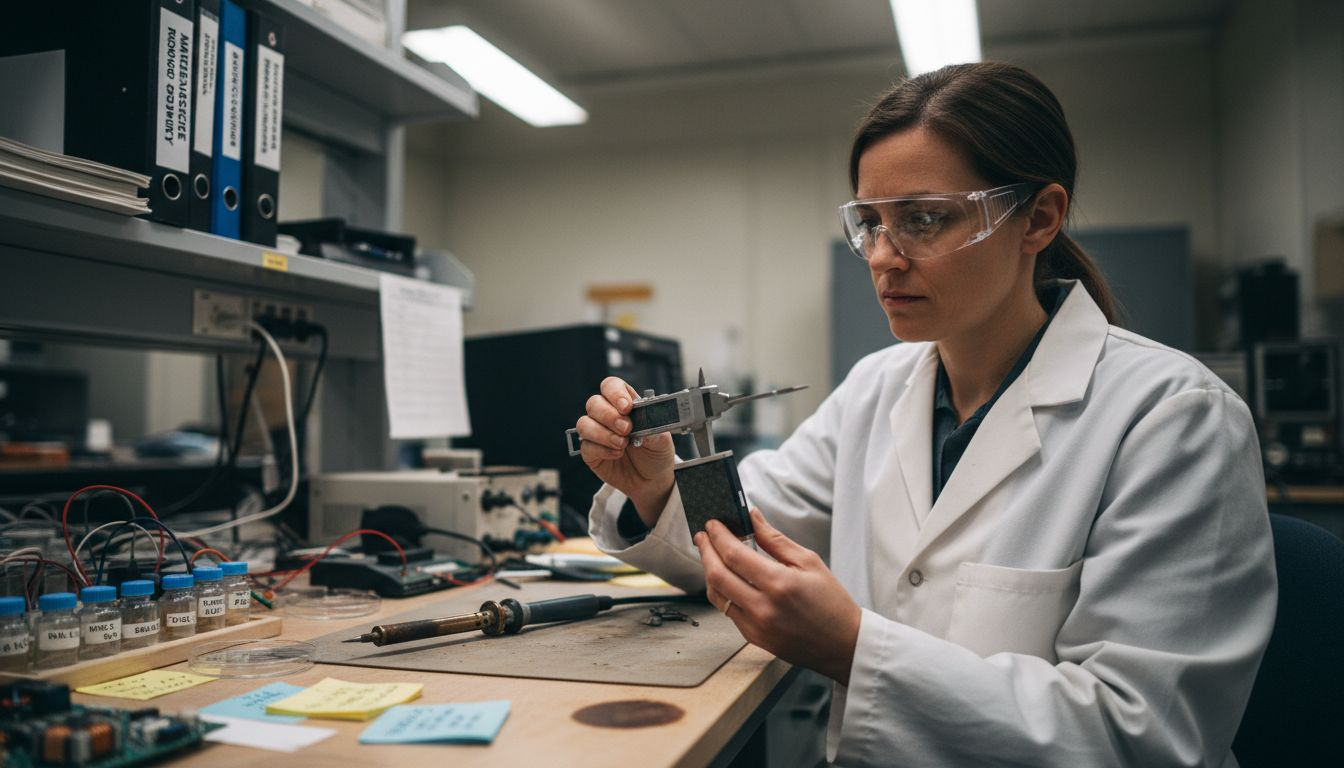
Graphene supercapacitors are shattering old assumptions about energy storage. Many energy managers dismiss supercapacitors as low-capacity devices suited only for niche power bursts. Yet advanced graphene versions now achieve energy densities up to 200 Wh/L, rivaling lead-acid batteries while cycling millions of times without degradation. For Benelux energy managers seeking sustainable, high-performance storage, these devices offer a compelling alternative that complements traditional batteries in residential and commercial systems.
Table of Contents
Key Takeaways
Point | Details |
Energy Density | Graphene supercapacitors reach 200 Wh/L, matching lead-acid batteries with far superior power delivery. |
Cycle Life | They outlast lithium-ion batteries by 50 to 1000 times, cycling hundreds of thousands to millions of times. |
Sustainability | Free from cobalt and lithium, they reduce supply risks and enable effective recycling of materials. |
Power Performance | Discharge rates exceed 2.6 kW/L, enabling rapid energy release for grid stability and peak shaving. |
EMS Integration | Modular design scales from 2 kWh residential units to MW commercial arrays with dynamic tariff optimization. |
Introduction to Graphene Supercapacitors
Graphene supercapacitors store energy electrostatically rather than through chemical reactions like batteries. This fundamental difference enables lightning-fast charge and discharge cycles that can repeat millions of times without significant capacity loss. Graphene electrodes deliver exceptional surface area and electrical conductivity, creating an ideal platform for rapid electron movement.
The material’s atomic structure allows for densely packed charge storage sites. You benefit from devices that charge in seconds rather than hours. This speed advantage makes graphene supercapacitors perfect for applications requiring frequent power bursts, such as regenerative braking in vehicles or grid frequency regulation.
These devices have matured beyond laboratory curiosities. Commercial manufacturers now produce units for industrial and residential deployment. Energy managers can specify graphene supercapacitors for installations requiring durability, speed, and minimal maintenance across decades of operation.
Key advantages include:
Electrostatic storage mechanism eliminates chemical degradation
High surface area graphene enables rapid charge transfer
Lifecycle exceeds one million charge/discharge cycles
Operating temperature range from negative 40°C to positive 70°C
Minimal capacity fade over extended use periods
Pro Tip: When evaluating storage technologies, consider the total cost of ownership over 20 years rather than upfront price alone, as graphene supercapacitors’ extended lifecycle often delivers superior economics despite higher initial investment.
Performance Comparison: Supercapacitors vs Batteries
Quantitative metrics reveal where graphene supercapacitors excel and where batteries maintain advantages. Graphene supercapacitors deliver energy densities up to 200 Wh/L and power densities exceeding 2.6 kW/L, outperforming lead-acid batteries on both counts. Power density represents the critical differentiator: supercapacitors discharge their stored energy in under one minute, while batteries typically require 30 minutes to several hours for full discharge.
Cycle life spans hundreds of thousands to millions of operations, vastly exceeding lithium-ion batteries’ typical 500 to 2,000 cycles. This durability translates to decades of service without replacement. For applications cycling daily, graphene supercapacitors can operate for 30 to 50 years, while lithium-ion batteries require replacement every 3 to 8 years.

Metric | Graphene Supercapacitor | Lithium-Ion Battery | Lead-Acid Battery |
Energy Density (Wh/L) | Up to 200 | 250 to 700 | 80 to 90 |
Power Density (kW/L) | 2.6+ | 0.3 to 1.5 | 0.1 to 0.2 |
Cycle Life | 100,000 to 1,000,000+ | 500 to 2,000 | 200 to 500 |
Discharge Time | Under 1 minute | 30 min to hours | 1 to 8 hours |
Operating Temp (°C) | Negative 40 to 70 | 0 to 45 | Negative 20 to 50 |
Batteries maintain higher energy density for applications requiring sustained energy supply over hours. Supercapacitors dominate where rapid power delivery and cycling frequency matter most. Smart energy systems leverage both technologies in complementary roles, using supercapacitors for power management and batteries for capacity reserve.
You should match technology to application requirements. Peak shaving, frequency regulation, and power quality applications favor supercapacitors. Overnight backup power and seasonal storage lean toward batteries. Residential storage systems increasingly combine both for optimal performance.
Pro Tip: For Benelux installations cycling storage daily with dynamic tariff optimization, graphene supercapacitors’ unlimited cycling advantage eliminates the replacement costs that erode battery system economics over 20-year project lifespans.
Environmental Impact and Sustainability
Graphene oxide production represents the primary environmental hotspot in supercapacitor manufacturing, consuming significant energy during synthesis and processing. Manufacturing facilities can reduce this impact through renewable energy use and process optimization. The production phase accounts for approximately 70% of lifecycle environmental burden, making manufacturing efficiency critical for sustainability.
Recycling dramatically reduces environmental impact by recovering graphene, PTFE binder, and aluminum components. End-of-life processing reclaims materials for reuse, cutting both waste generation and virgin material demand. Recycling programs can recover over 85% of component materials, substantially lowering lifecycle footprint compared to landfill disposal.
Graphene electrodes avoid critical raw materials like cobalt and lithium, eliminating supply chain risks associated with conflict minerals and geopolitically concentrated resources. This material independence enhances long-term availability and price stability. You gain supply security that battery-dependent systems cannot match, particularly important for multi-decade infrastructure investments.
Key sustainability factors:
Manufacturing energy intensity drives lifecycle impact more than material extraction
Recycling programs reduce environmental burden by 60% compared to disposal
Absence of conflict minerals simplifies ethical sourcing requirements
Extended operational life reduces replacement frequency and associated manufacturing impacts
Carbon footprint decreases with renewable energy use in production facilities
Energy managers planning large installations should specify recycling provisions in procurement contracts. Sustainable battery strategies emphasize circular economy principles that apply equally to supercapacitors, ensuring materials flow back into manufacturing streams rather than waste disposal.
Common Misconceptions About Supercapacitors
Myth: Supercapacitors store too little energy for practical applications. Reality: Advanced nitrogen-doped graphene supercapacitors achieve energy density comparable to lead-acid batteries and approach entry-level lithium-ion performance. Recent material innovations have closed the energy density gap that historically limited supercapacitor adoption. Modern units deliver sufficient capacity for hours of power delivery in residential and light commercial applications.
Myth: Supercapacitors wear out quickly like older capacitor technologies. Reality: Graphene supercapacitors cycle counts exceed 100,000 to millions, far surpassing typical battery lifespans. The electrostatic storage mechanism eliminates chemical degradation pathways that limit battery durability. Field deployments demonstrate minimal capacity fade after tens of thousands of cycles, validating laboratory projections of million-cycle operational life.
Myth: Supercapacitors use critical metals that negate sustainability benefits. Reality: Graphene supercapacitors avoid cobalt and lithium entirely, relying on carbon-based electrodes and common electrolyte materials. This material composition enhances both environmental profile and supply chain resilience. You eliminate exposure to price volatility and geopolitical risks affecting battery raw materials.
Addressing these misconceptions:
Material advances have overcome historical energy density limitations that restricted early supercapacitors to niche applications
Electrostatic storage principles enable cycling durability impossible with chemical storage mechanisms
Carbon-based electrode materials provide sustainable, abundant alternatives to critical battery minerals
Commercial manufacturing now delivers performance specifications previously confined to research laboratories
Pro Tip: When comparing storage options, request cycle life data at your expected depth of discharge rather than manufacturer maximum ratings, as real-world operating conditions significantly affect durability projections for all storage technologies.
Integration and Application in Benelux Energy Systems
Graphene supercapacitor systems scale modularly from 2 kWh residential units to MW commercial banks integrated with energy management systems for tariff optimization and grid services. This flexibility allows you to size installations precisely to load requirements without oversizing. Residential deployments typically combine 8 to 16 kWh of supercapacitor capacity with solar PV for daily cycling, while commercial installations may deploy 400 kWh modules in parallel for MW-scale power delivery.
Integration with Belinus EMS enables real-time 15-minute tariff optimization and demand response for cost efficiency. The system monitors grid pricing continuously, charging supercapacitors during low-cost periods and discharging during peak tariff windows. This arbitrage function can reduce energy costs by 15% to 30% in Benelux markets with dynamic pricing structures.
Rapid charge and discharge capabilities support grid stability, peak shaving, and energy trading use cases. Supercapacitors respond to grid frequency deviations within milliseconds, providing ancillary services that utilities increasingly value. Commercial operators can monetize these capabilities through grid service contracts that generate revenue beyond simple energy arbitrage.
Application | Supercapacitor Role | Battery Role |
Peak Shaving | Primary device, rapid response | Secondary reserve, extended duration |
Frequency Regulation | Millisecond response, unlimited cycles | Backup for sustained events |
Tariff Arbitrage | Multiple daily cycles without degradation | Overnight/weekly cycling |
Power Quality | Instantaneous voltage support | Not typically used |
Backup Power | Short duration, high power events | Extended outages, lower power |
Key integration considerations:
Power conversion systems must handle rapid charge/discharge transients
EMS software requires real-time pricing data feeds for optimization
Grid interconnection agreements should specify ancillary service capabilities
Hybrid systems combining supercapacitors and batteries optimize both power and energy delivery
Modular architecture enables phased capacity expansion as loads grow
You can deploy supercapacitors alongside existing battery systems to extend battery life by handling high-frequency cycling. This hybrid approach maximizes the strengths of both technologies while minimizing weaknesses. The supercapacitor absorbs rapid power fluctuations that would otherwise stress battery chemistry, while batteries provide the energy capacity for sustained discharge periods.
Pro Tip: For commercial installations planning to offer grid services, specify supercapacitor capacity at 20% to 30% of peak load to capture most peak shaving and frequency regulation value without excessive capital investment, as cost-benefit analysis shows diminishing returns beyond this ratio.
Conclusion and Future Outlook
Graphene supercapacitors deliver unmatched power density and cycling durability that complement battery energy storage in modern grid-connected systems. Their ability to discharge rapidly and cycle indefinitely positions them as essential components for dynamic tariff optimization, grid stability services, and power quality management. As Benelux energy markets increasingly value flexibility and fast response, supercapacitors provide capabilities that batteries cannot match.
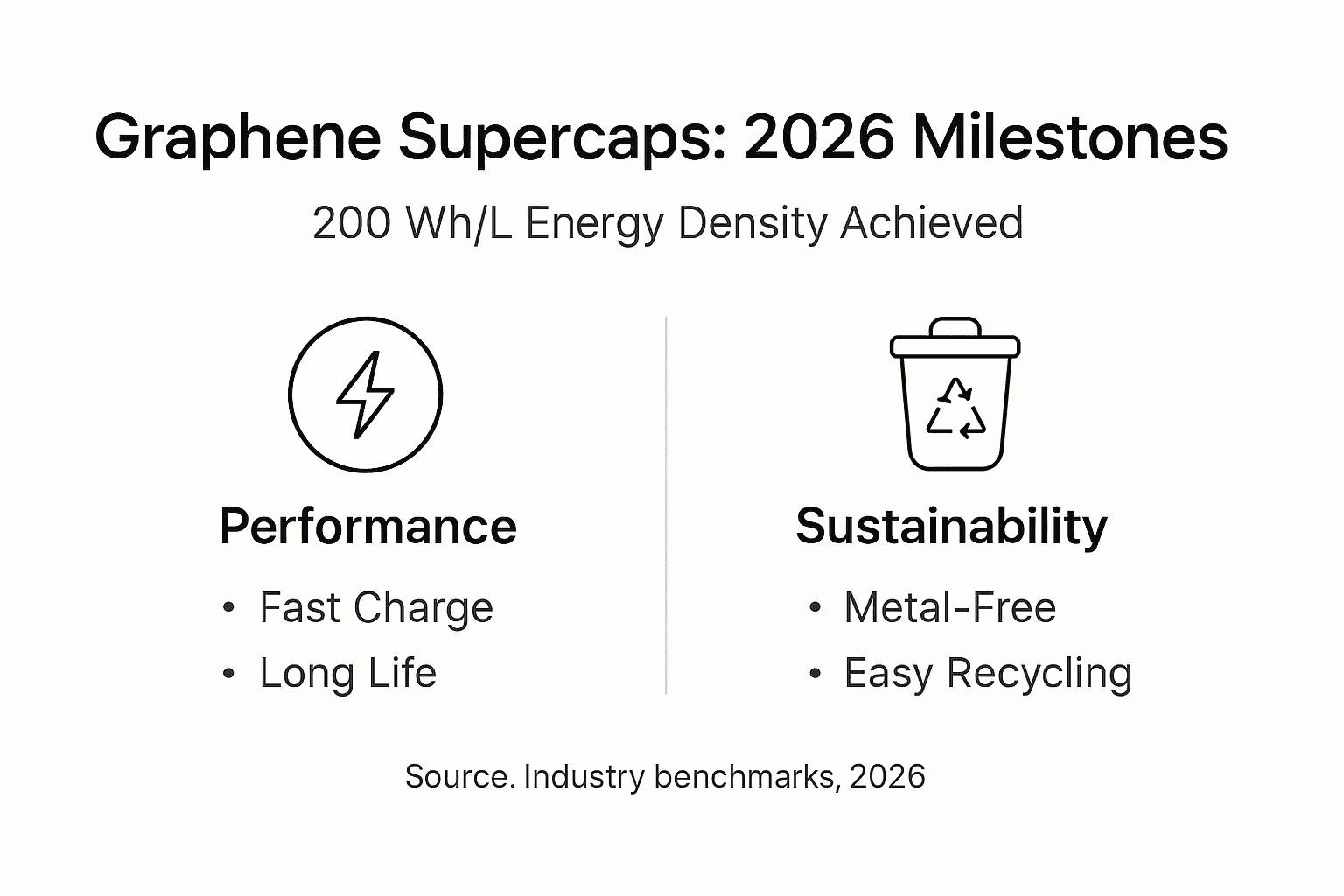
Sustainability improvements hinge on refining manufacturing processes and establishing robust recycling infrastructure. Current lifecycle assessments identify graphene oxide production as the primary environmental hotspot, suggesting clear pathways for impact reduction through renewable energy adoption and process efficiency gains. The absence of critical minerals enhances long-term supply security compared to battery-dependent strategies.
Advances in nitrogen-doped graphene promise expanding energy storage roles as researchers push density boundaries closer to lithium-ion battery levels. Emerging hybrid configurations combining supercapacitors with multiple battery chemistries will optimize system performance across diverse operating conditions. Energy managers positioned to integrate these technologies gain competitive advantages in cost management, grid service revenue, and system longevity that translate directly to improved project economics over multi-decade lifespans.
Enhance Your Energy Storage with Belinus Solutions
Belinus delivers comprehensive energy storage and management solutions optimized for Benelux residential and commercial applications. Our Energy Wall G1 graphene supercapacitor system integrates seamlessly with solar PV installations, providing 16 kWh of rapid-cycling capacity for daily tariff optimization. The centralized EMS coordinates supercapacitor operation with grid pricing, battery reserves, and EV charging to maximize cost savings and energy independence.

Explore battery storage setup options that combine supercapacitor power delivery with lithium-ion energy capacity for hybrid systems delivering both rapid response and extended duration. Our technical team designs custom configurations scaled to your specific load profile, cycling requirements, and grid service objectives. Whether deploying residential systems or MW-scale commercial installations, graphene supercapacitor solutions from Belinus position you at the forefront of sustainable energy technology.
Frequently Asked Questions
How do graphene supercapacitors differ from traditional lithium-ion batteries?
Graphene supercapacitors store energy electrostatically through surface charge accumulation, enabling charge and discharge cycles completed in seconds rather than hours. Lithium-ion batteries rely on chemical reactions that move ions between electrodes, delivering higher energy density but much slower response times. The electrostatic mechanism allows supercapacitors to cycle millions of times without degradation, while chemical processes limit batteries to thousands of cycles before capacity fade requires replacement.
Can graphene supercapacitors fully replace batteries in residential energy systems?
Supercapacitors excel at power delivery and unlimited cycling but currently offer lower energy density than batteries for extended discharge durations. They work optimally alongside batteries in hybrid configurations, with supercapacitors handling rapid cycling for tariff arbitrage and power quality while batteries provide overnight backup capacity. This complementary approach delivers superior system performance and economics compared to either technology alone, maximizing the strengths of each while minimizing weaknesses.
What sustainability benefits do graphene supercapacitors offer?
They eliminate dependence on critical metals like cobalt and lithium, reducing both environmental impact and supply chain risks associated with conflict minerals and geopolitically concentrated resources. Effective recycling programs recover over 85% of component materials including graphene, PTFE, and aluminum for reuse in new manufacturing. The extended operational lifespan reduces replacement frequency and associated manufacturing impacts compared to batteries requiring replacement every few years.
How can graphene supercapacitors be integrated into existing EMS in Benelux?
They feature modular, scalable architecture compatible with energy management systems like Belinus that coordinate real-time tariff optimization and demand response. Installation requires power conversion equipment to interface supercapacitors with existing electrical infrastructure and communication links for EMS coordination. The rapid charge and discharge capabilities enable grid stability services including peak shaving, frequency regulation, and power quality management that generate both cost savings and potential grid service revenue for commercial operators.
Recommended
Comments