Sustainable Building Energy Guide for 2026
- Jul 12
- 8 min read

TL;DR:
Building energy standards focus on reducing carbon emissions and improving efficiency through regulations like the EPBD. These standards require all new buildings to be zero-emission by 2030 and emphasize the importance of renewable energy, energy management systems, and lifecycle assessments. Implementing these strategies from design to operation is essential for compliance, cost savings, and sustainable performance.
A sustainable building energy guide covers the methods, standards, and technologies that reduce energy consumption, cut carbon emissions, and keep buildings compliant with evolving regulations. Buildings account for approximately 40% of total EU energy consumption and 36% of energy-related greenhouse gas emissions. That single statistic explains why regulators, lenders, and buyers now treat energy performance as a core building requirement, not an optional upgrade. Builders, architects, and homeowners who integrate energy-efficient building strategies from day one avoid costly retrofits and stay ahead of tightening rules.
What are the core standards guiding sustainable building energy in 2026?
The Energy Performance of Buildings Directive (EPBD) is the primary regulatory framework shaping sustainable building energy across Europe. Its 2024 recast sets binding targets that affect every new build and major renovation starting now.
By january 2030, all new buildings must qualify as zero-emission buildings, meaning very high energy performance and zero on-site fossil fuel combustion. Public buildings face the earlier deadline of 2028. That phased timeline gives builders and architects a narrow window to redesign their standard specifications.
The EPBD also introduces Minimum Energy Performance Standards (MEPS) for existing non-residential stock. At least 16% of the worst-performing non-residential buildings must meet MEPS by 2030, rising to 26% by 2033. Owners of office buildings, retail spaces, and public facilities need renovation plans in place now, not in 2029.
Three additional requirements define the 2026 regulatory picture:
Whole-life carbon calculations: The 2024 EPBD recast mandates lifecycle carbon assessments using EN 15978 methodology for new buildings above 1,000 m² starting 2028, extended to all new buildings by 2030.
Energy Performance Certificates (EPCs): EPCs are valid for a maximum of 10 years and must be issued by certified energy specialists. Renovations and property transactions trigger mandatory renewals.
Smart building automation: Non-residential buildings must install automation systems that support energy optimization and indoor environmental quality as part of EPBD compliance.
Pro Tip: Commission your whole-life carbon assessment at the design stage. Retroactive calculations cost significantly more and often reveal problems that are expensive to fix after construction begins.
Which renewable energy resources optimize sustainable building energy?
Solar photovoltaic (PV) systems are the most widely applicable renewable energy resource for both residential and commercial buildings. A well-sized PV array paired with battery storage covers the majority of a building’s daytime load and feeds surplus energy back to the grid or into storage for evening use.
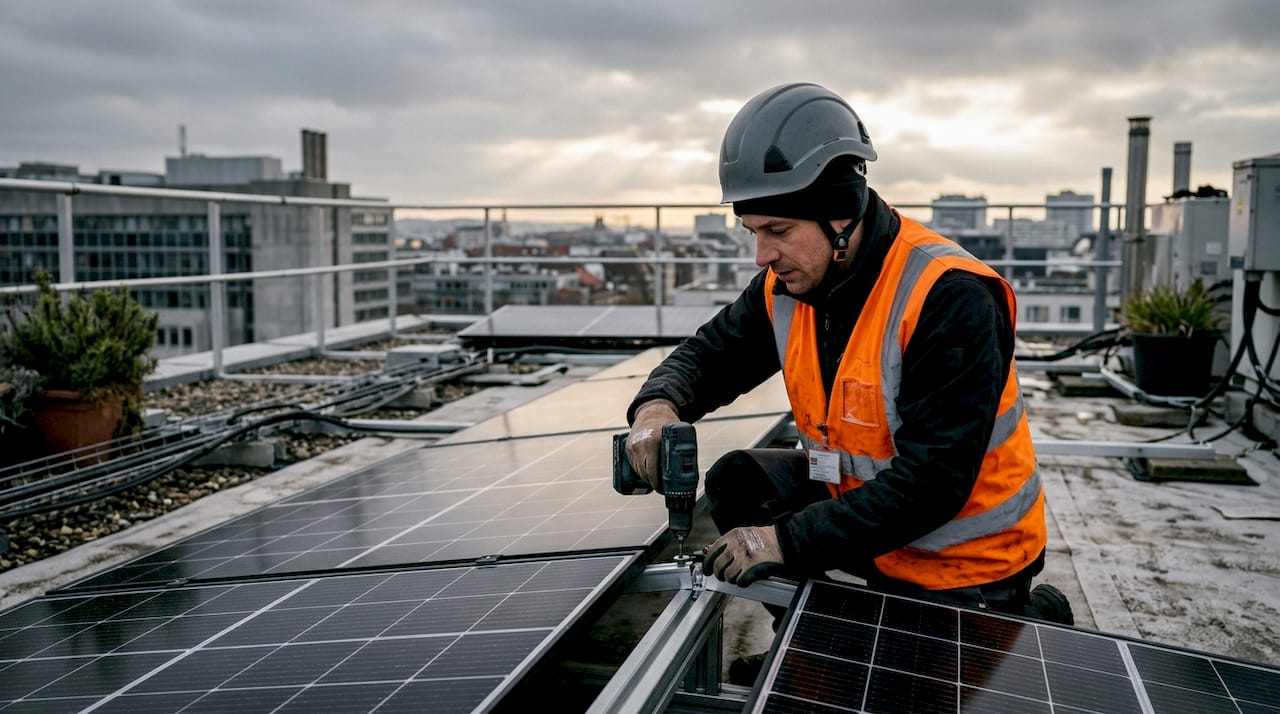
Selecting the right technology depends on three factors: building type, location, and budget. Residential projects in northern Europe typically size PV systems between 5 kW and 15 kW. Commercial buildings with large roof areas or parking structures can support significantly larger arrays. Integrating renewables into your energy system requires matching generation capacity to actual consumption patterns, not just peak demand.
Battery storage is the component that converts a good solar installation into a genuinely self-sufficient building. Without storage, excess generation is exported at low feed-in tariff rates. With storage, that energy covers evening and overnight loads at full retail value. Belinus offers the Energy Wall G1, a 16 kWh graphene supercapacitor storage unit priced at €7,000 per unit, with a Q1 2026 launch. For larger commercial or utility applications, Belinus utility storage modules scale from 400+ kWh to MW capacity.
Key selection criteria for renewable energy technologies:
PV system sizing: Match array output to annual consumption data, not just peak summer generation.
Inverter compatibility: Solis inverters in the 5–25 kW range integrate directly with the Belinus Energy Management System (EMS) for real-time optimization.
Grid readiness: Buildings designed for smart grid interaction can participate in energy trading and demand response programs.
Low-carbon materials: Specify insulation, structural panels, and glazing with verified embodied carbon data to reduce whole-life carbon scores.
Pro Tip: Pair your PV system with an energy management system that uses 15-minute dynamic tariff data. Belinus EMS does exactly this, shifting charge and discharge cycles to match the cheapest grid periods automatically.
How to implement energy-efficient building strategies throughout the project lifecycle
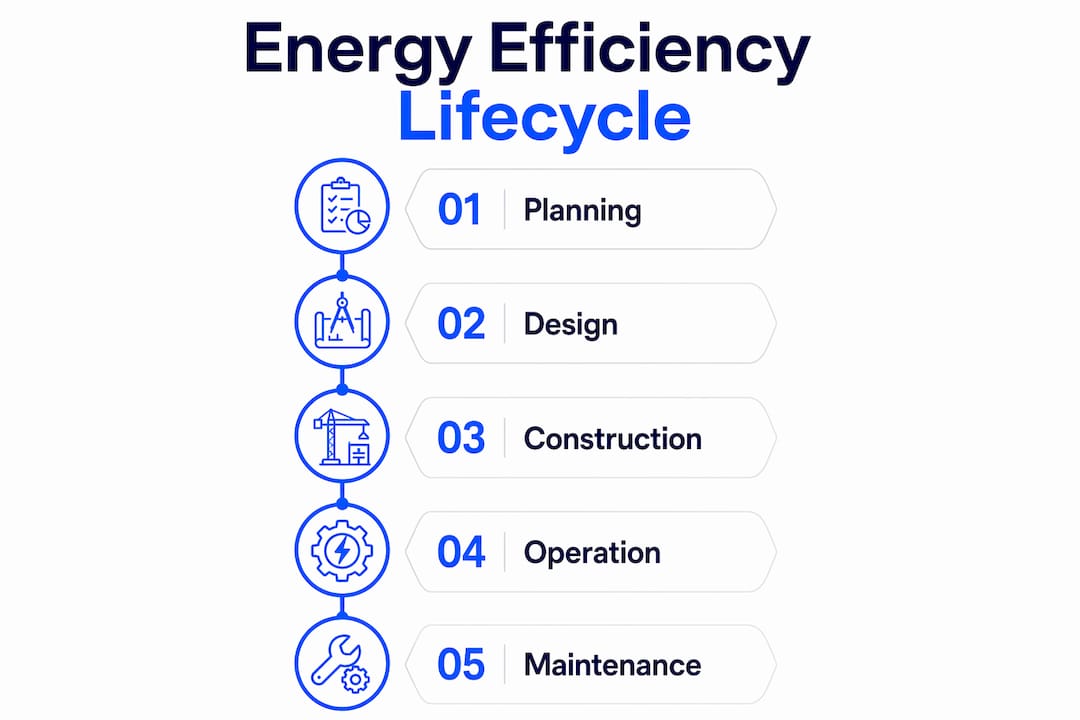
Energy efficiency is not a single decision. It is a sequence of choices made at every project phase, from the first site survey to ongoing building operation.
Pre-construction planning
Start with a lifecycle assessment (LCA) that captures both operational and embodied carbon. Digital building logbooks are becoming central to compliance and lending decisions, replacing fragmented paper records. Set up your logbook before breaking ground so that every material specification, energy model, and inspection record feeds into a single auditable file.
Design phase
The building envelope is the single most cost-effective place to invest in energy performance. High-performance insulation, triple-glazed windows, and airtight construction reduce heating and cooling loads before any mechanical system is specified. Passive solar building techniques, including south-facing glazing, thermal mass floors, and shading overhangs, cut heating demand without adding equipment. HVAC systems should be sized to the reduced load of a well-insulated envelope, not to the load of a standard-spec building.
Construction phase
A four-step construction protocol keeps energy performance on track:
Verify airtightness with a blower door test before closing walls. Fixing air leaks at this stage costs a fraction of post-construction remediation.
Document material specifications in the digital building logbook as each layer is installed. This supports future EPC renewals and renovation passports.
Pre-wire for renewables even if PV and storage are not installed at handover. Conduit runs and electrical panel capacity cost little at construction and eliminate major disruption later.
Commission mechanical systems before occupancy. Heating curves, pump controls, and ventilation setpoints set at commissioning directly determine operational energy use.
Operation and maintenance
Optimized heating curves, pump controls, and system tuning can reduce building energy use by up to 20% without major renovations. That figure applies to existing buildings where systems were never properly commissioned. For new builds, continuous monitoring through a platform like Belinus EMS catches drift before it becomes waste. The EMS dashboard tracks generation, consumption, storage state, and grid interaction in real time, giving building managers the data to act quickly.
Project phase | Key action | Primary benefit |
Pre-construction | Lifecycle assessment and digital logbook setup | Compliance readiness and cost visibility |
Design | Envelope optimization and passive solar design | Reduced mechanical load |
Construction | Airtightness testing and renewable pre-wiring | Lower retrofit costs |
Operation | Continuous EMS monitoring and system tuning | Up to 20% energy reduction |
What challenges arise in sustainable building energy projects?
The most common barrier is upfront cost. High-performance insulation, triple glazing, PV systems, and battery storage all carry higher initial price tags than standard-spec alternatives. The financial case improves significantly over a 25-year horizon, but builders and homeowners often focus on the first-year budget.
A second barrier is regulatory complexity. Many builders misread the EPBD’s renovation requirements. Private residential buildings face no mandatory renovation deadline solely because of a poor EPC rating. The legally binding MEPS deadlines apply to non-residential stock. Homeowners renovate in response to market forces and transaction requirements, not direct legal mandates. Knowing this distinction prevents unnecessary panic and helps prioritize spending correctly.
“Support programs and one-stop shops are increasing to help vulnerable households and SMEs adopt high-efficiency heating and solar systems, directly addressing the cost barrier that stops most projects before they start.”
Practical solutions for the most common obstacles:
Funding and incentives: National renovation funds, EU Cohesion funds, and utility rebate programs offset 20–40% of upfront costs in many EU member states. Check your national renovation plan for current rates before finalizing a project budget.
Technical assistance: One-stop shop programs provide coordinated support covering energy audits, contractor selection, financing, and permit applications under one roof. These programs exist specifically for homeowners and SMEs who lack in-house expertise.
System integration delays: Specify equipment with open communication protocols (Modbus, RESTful API) from the start. Proprietary systems create integration bottlenecks that delay commissioning and increase costs.
Operational inefficiencies: Operators should monitor and adjust heating setpoints, flow rates, and schedules aggressively. These adjustments deliver measurable savings within weeks, not months.
Pro Tip: Apply for incentive programs before signing construction contracts. Many grants require pre-approval, and retroactive applications are rarely accepted. Check boiler efficiency standards for 2026 if your project includes heating system upgrades, as compliance requirements affect equipment eligibility for subsidies.
Key Takeaways
Sustainable building energy performance depends on integrating regulatory compliance, renewable technology, and continuous operational monitoring from the earliest project phase.
Point | Details |
EPBD sets hard deadlines | All new buildings must be zero-emission by 2030; public buildings by 2028. |
MEPS targets non-residential stock | 16% of worst-performing non-residential buildings must meet standards by 2030. |
Storage multiplies solar value | Battery storage converts surplus PV generation into usable evening and overnight power. |
Digital logbooks are now compliance tools | Building logbooks link energy data, renovation records, and EPC data for lenders and regulators. |
Operational tuning delivers fast savings | Adjusting heating curves and pump controls cuts energy use by up to 20% without major renovations. |
Why I think most builders are still solving the wrong problem
After working closely with building energy projects across Europe, the pattern I see most often is this: builders invest heavily in renewable technology and then underinvest in the systems that manage it. A 15 kW PV array paired with a poorly configured inverter and no energy management system delivers a fraction of its potential value. The hardware is not the bottleneck. The data layer is.
The EPBD’s push toward zero-energy home design is actually an opportunity disguised as a compliance burden. Buildings that meet zero-emission standards today command premium valuations, attract better tenants, and qualify for lower-rate green financing. The builders who treat the 2028 and 2030 deadlines as a ceiling rather than a floor will find themselves renovating again in five years.
The other shift I advocate for is treating whole-life carbon as a design input, not a reporting exercise. Specifying low-embodied-carbon materials at the design stage costs nothing extra in design time and often costs less in materials when you compare alternatives systematically. Waiting until the building is half-built to run an EN 15978 calculation is like checking your fuel gauge after you’ve already run out.
My honest recommendation: start every project with a digital building logbook, a whole-life carbon target, and an energy management specification. Everything else, the PV array, the storage, the HVAC, follows from those three decisions.
— Marc
How Belinus supports your sustainable building projects
Builders and architects who want to meet 2026 energy standards without guesswork have a clear path forward with Belinus.
Belinus provides solar PV integration, battery storage, and EV charging solutions connected through its centralized Energy Management System. The EMS uses 15-minute dynamic tariff data to shift energy use automatically, reducing grid costs and maximizing self-consumption. For residential projects, the Energy Wall G1 and Solis inverters form a complete generation and storage package. For commercial and utility-scale projects, Belinus designs custom systems from small commercial installations to MW-scale deployments. The Belinus Quotation Software models 25-year financial performance automatically, giving clients the data they need to make confident investment decisions. Visit belinus.com to request a system design consultation.
FAQ
What is a zero-emission building under the EPBD?
A zero-emission building has very high energy performance and produces zero on-site fossil fuel emissions. The EPBD requires all new buildings to meet this standard by 2030, with public buildings required to comply by 2028.
Do homeowners have to renovate if their EPC rating is poor?
Private residential buildings face no legally binding renovation deadline based on EPC ratings alone. MEPS deadlines apply to non-residential buildings; residential renovations are driven by market forces and transaction requirements.
How long does an Energy Performance Certificate last?
An EPC is valid for a maximum of 10 years. Renovations and property transactions trigger mandatory renewals, and certificates must be issued by certified energy specialists.
What is the fastest way to reduce a building’s energy use?
Adjusting heating curves, pump controls, and system schedules delivers energy reductions of up to 20% in existing buildings without major renovations. This operational tuning is the fastest and lowest-cost improvement available.
How does battery storage improve solar energy performance?
Battery storage captures surplus PV generation that would otherwise be exported at low feed-in tariff rates. That stored energy covers evening and overnight loads at full retail value, significantly improving the financial return on a solar installation.
Recommended
Comments