Smart charging for EVs: maximize efficiency and cut costs
TL;DR:
Smart charging optimizes energy flow by responding to grid needs, prices, and renewable generation.
Integrating solar, storage, and EMS maximizes household savings up to €1,200 annually.
Regulations in Europe are mandating smart charging features in new buildings, ensuring future compatibility.
Most property owners assume plugging in an EV is a straightforward but expensive affair that quietly strains the grid. That assumption is costing them money. In Germany, households combining solar PV, heat pumps, and EVs with a smart energy management system are saving up to €1,200 per year on energy bills. Smart charging does not just reduce what you spend at the outlet. It turns your EV into an active participant in how energy flows through your property and, at scale, through the entire grid. This guide breaks down how smart charging works, which models deliver the best results, and what you need to do right now to capture those savings.
Table of Contents
What is smart charging? Core principles and technology explained
Residential smart charging: Real-world cost savings and best practices
Smart charging for workplaces and commercial property: Advantages and challenges
Critical risks, regulations, and the future of smart charging in Europe
What most guides miss: The true value (and limits) of smart charging in Europe
Ready to upgrade? Next steps for smart charging and sustainable energy
Key Takeaways
Point | Details |
Maximize charging savings | Smart charging can lower annual EV energy costs by over a quarter, especially when paired with solar or flexible tariffs. |
Support grid stability | Both homes and businesses use smart charging to balance demand and reduce peak loads, aiding overall energy reliability. |
Plan for futureproof installations | Choosing proven protocols and compliance with new EU rules ensures long-term interoperability and investment protection. |
Integrate with renewables | Combining smart charging with solar or energy management systems multiplies both savings and sustainability benefits. |
What is smart charging? Core principles and technology explained
Standard EV charging is blunt. You plug in, and the charger draws maximum power until the battery is full. It does not care whether electricity costs twice as much at 6 p.m. as it does at midnight. It does not know your solar panels are generating surplus power. It simply pulls from the grid at whatever rate it can.
Smart charging is fundamentally different. It adjusts EV power flow based on grid needs, renewable energy availability, time-varying prices, and your own preferences, using protocols like OCPP (Open Charge Point Protocol) and ISO 15118. Those protocols are the language that chargers, vehicles, and grid operators use to talk to each other in real time.
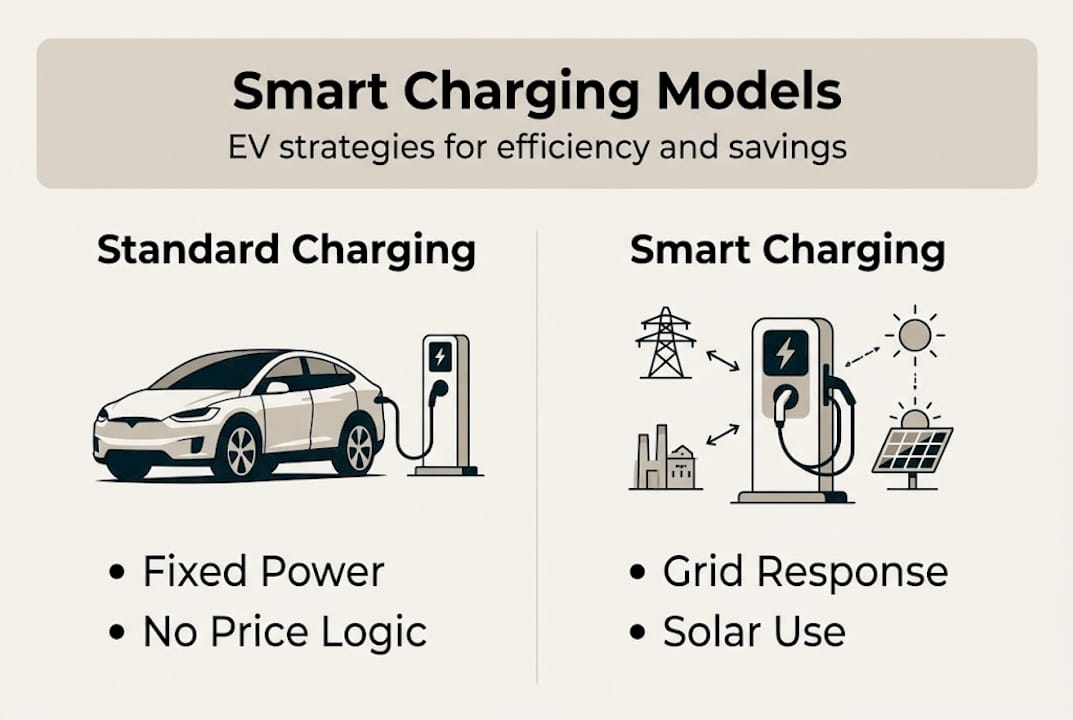
At the center of any smart charging setup is an Energy Management System, or EMS. Think of it as the conductor of an orchestra. It monitors electricity prices, tracks solar output, reads grid signals, and decides exactly when and how fast your EV charges. Energy management systems like the one Belinus uses operate on 15-minute dynamic tariff cycles, meaning the system is constantly recalibrating to find the cheapest, cleanest window to charge your vehicle.
Key components of a smart charging setup:
EMS: Coordinates all devices and energy flows across the property
OCPP-compatible charger: Enables remote control and real-time communication
ISO 15118 support: Allows plug-and-charge and bidirectional communication with the vehicle
RESTful API: Connects third-party systems, tariff feeds, and grid operator signals
Mobile or web dashboard: Lets you monitor and override settings manually
Feature | Standard charging | Smart charging |
Responds to electricity prices | No | Yes |
Uses solar surplus | No | Yes |
Adjustable charging speed | No | Yes |
Grid signal integration | No | Yes |
Remote control | No | Yes |
In practice, smart charging kicks in automatically. When your solar panels produce more than your home needs, the EMS redirects that surplus to your EV instead of exporting it at a low feed-in rate. When grid prices spike in the early evening, charging pauses and resumes after midnight when rates drop. You set the rules once, and the system handles the rest.
Main smart charging models and grid integration benefits
Not all smart charging is created equal. There are three primary models, each with a different relationship between your vehicle and the grid.
V1G (unidirectional smart charging) is the most widely deployed today. The charger controls when and how fast the EV charges, but energy only flows one way: from the grid or solar panels into the battery. It is the easiest to implement, works with most current EVs, and already delivers meaningful savings.

V2G (vehicle-to-grid) goes further. Energy flows both ways. Your EV can discharge stored power back to the grid during peak demand periods, earning you revenue or credits from grid operators. V2X (vehicle-to-everything) extends this to include powering your home (V2H) or other local loads (V2B for building).
Methodologies include unidirectional V1G controlled charging, bidirectional V2G/V2X for grid support, peak shaving, load balancing, and alignment with solar PV or low-carbon periods via EMS and APIs. Each approach targets a different layer of value.
Model | Energy direction | Main benefit | Main challenge |
V1G | One-way (grid to EV) | Cost savings, solar use | Limited grid revenue |
V2G | Two-way (EV to grid) | Grid revenue, peak shaving | Battery wear, compatibility |
V2X | Two-way (EV to building/home) | Resilience, self-consumption | Hardware cost, regulation |
Coordinated strategies reduce residential charging costs by up to 26.62% and cut peak load significantly. For grid operators, coordinated EV charging is equally valuable. It smooths out demand spikes, supports renewable integration, and reduces the need for expensive grid reinforcement.
Grid-level benefits of smart charging:
Flattens peak demand curves
Absorbs excess solar and wind generation
Reduces strain on local distribution networks
Enables dynamic load balancing across neighborhoods
Explore grid flexibility strategies and multi-technology integration to understand how these models fit into a broader property energy strategy.
Pro Tip: Before investing in V2G hardware, confirm your EV model and charger both support ISO 15118-20 bidirectional communication. Many vehicles sold before 2024 do not, and retrofitting is rarely cost-effective.
Residential smart charging: Real-world cost savings and best practices
The numbers are striking. German households with solar PV, heat pumps, and EVs managed through a smart EMS are saving up to €1,200 annually. That is not a theoretical projection. It reflects real-world optimization across multiple energy loads working together.
Savings spotlight: Combining smart EV charging with rooftop solar and a heat pump can save European homeowners up to €1,200 per year through coordinated energy management.
But savings do not appear automatically. They depend on the right setup and habits. Here is how to maximize what smart charging delivers at home:
Install a time-of-use electricity tariff. Without dynamic pricing, smart charging has far less to optimize. Contact your utility or check if your energy supplier offers hourly or block-rate tariffs.
Add rooftop solar. Smart charging’s biggest residential win comes from consuming your own generation instead of exporting it cheaply and buying back expensively. Learn more about residential solar strategies to size your system correctly.
Integrate battery storage. A home battery buffers solar surplus for evening EV charging, extending self-consumption windows. See how solar and storage integration works in practice.
Connect all loads to a single EMS. Charging your EV in isolation misses the bigger picture. When your EMS coordinates the EV, heat pump, battery, and solar together, savings compound. Explore home energy optimization for a full-system view.
Set departure time preferences. Most smart chargers let you specify when the vehicle must be fully charged. This allows the EMS to backfill overnight at the cheapest rates without leaving you stranded in the morning.
Smart charging delivers minimal value if you have no solar, no dynamic tariff, and charge during peak hours out of habit. The technology is only as powerful as the energy environment around it. Check out these energy-saving tips to build the right foundation first.
Pro Tip: If your utility offers a dedicated EV tariff with overnight off-peak rates, enable scheduled charging immediately, even before adding solar. It is the fastest, cheapest first step toward meaningful savings.
Smart charging for workplaces and commercial property: Advantages and challenges
Commercial properties face a different set of pressures. Energy costs are larger, grid connection fees are tied to peak demand, and the reputational value of sustainability is increasingly real. Smart charging addresses all three.
In a French grid case study focused on the Essonne region through 2040, smart charging reduced peak load by up to 6% and cut network reinforcement costs by 25%. For a commercial property manager, that translates directly into lower grid connection charges and deferred infrastructure spending.
The scale of the opportunity is growing fast. EU public chargers exceeded 1 million in 2024, with a target of 8.8 million by 2030. Smart charging is not optional at that scale. It is essential for grid stability.
“Smart charging is the mechanism that allows millions of new charging points to coexist with the existing grid without triggering a wave of costly reinforcement projects.”
Commercial benefits at a glance:
Reduces peak demand charges on commercial electricity contracts
Qualifies for grid flexibility incentives in several EU member states
Supports ESG reporting and green building certification
Enables fleet cost optimization through energy storage for grid support
Site type | Key smart charging benefit | Primary challenge |
Office parking | Peak shaving, employee benefit | Variable dwell times |
Logistics depot | V2G revenue, fleet optimization | Protocol interoperability |
Multi-family housing | Shared load management | Billing complexity |
Retail | Customer attraction, grid credits | High turnover, short dwell |
The main barriers for commercial operators are dwell time variability, legacy charger incompatibility, and the complexity of managing multiple protocols across a mixed fleet. Future-proofing means specifying OCPP 2.0.1 and ISO 15118 compliance in every new charger procurement, not as a nice-to-have but as a baseline requirement.
Critical risks, regulations, and the future of smart charging in Europe
Smart charging is not without its complications. Understanding the risks upfront saves costly mistakes later.
On the technical side, optional EV parameters like EVEnergyRequest lead to conservative assumptions by the EMS, mid-session renegotiation creates friction when grid conditions change rapidly, and V2G carries real battery degradation risk if not managed carefully. Interoperability between charger brands, EV models, and charge point management systems remains an active challenge.
Key risks to manage:
Battery wear from frequent V2G discharge cycles
Protocol mismatches between legacy chargers and new EV models
Compliance complexity across different EU member state regulations
Cybersecurity exposure from connected charging infrastructure
Vendor lock-in from proprietary EMS platforms
On the regulatory side, the picture is clarifying. Prioritizing OCPP 2.0.1 and ISO 15118-20 is now the standard recommendation for future-proofing, and EU regulations including AFIR (Alternative Fuels Infrastructure Regulation) and EPBD (Energy Performance of Buildings Directive) are mandating smart charging features in new and majorly renovated buildings across Europe.
“Regulations are moving faster than most property owners realize. Buildings permitted today without smart charging readiness will face costly retrofits within five years.”
For property owners, the practical implication is straightforward. Any charger installed today that cannot be remotely updated, does not support open protocols, and lacks EMS integration is already obsolete by the standards being written into law. Explore solar consumption optimization to understand how regulatory compliance and energy efficiency intersect.
What most guides miss: The true value (and limits) of smart charging in Europe
Here is what we see that most guides skip over: smart charging’s real power is not in the charger. It is in the whole-building energy system the charger connects to. An EV charger optimized in isolation, without coordination with solar, storage, and dynamic tariffs, delivers a fraction of its potential value. The vehicle flexibility is the last piece, not the first.
V2G gets enormous attention, but V2G deployment lags significantly behind smart charging rollout broadly, held back by OEM caution around degradation warranties, regulatory gaps, and limited pilot scale. For most property owners in 2026, the practical focus should be on managed unidirectional V1G charging with full EMS integration. That is where the proven savings are.
What you should insist on from any vendor: open protocol support (OCPP 2.0.1 minimum), a clear roadmap for V2G upgradability, native renewable energy synchronization, and transparent data access. Vendors who cannot answer those questions clearly are selling you a product, not a solution. The property owners who will benefit most from smart charging over the next decade are the ones who build the right foundation now, not the ones who chase the most advanced feature set before the ecosystem is ready.
Ready to upgrade? Next steps for smart charging and sustainable energy
If this guide has shown you anything, it is that smart charging rewards preparation. The savings are real, the technology is proven, and the regulatory direction is clear. What varies is how well your property is set up to capture the full benefit.

At Belinus, we help residential and commercial property owners assess their smart charging readiness, design integrated solar and storage systems, and implement EMS solutions that coordinate every energy asset on site. Whether you are starting with a single home charger or planning a multi-site commercial fleet deployment, our team and our affiliated brands, Evonity for EV charging and SolarPlus for installations, are ready to help you build a system that performs today and scales with you tomorrow.
Frequently asked questions
How much can smart charging actually save on my energy bills?
In Europe, smart charging can cut residential charging costs by up to 26.62% and, when combined with solar and heat pumps, households can save up to €1,200 per year. Actual savings depend on your tariff structure, solar capacity, and how well your energy loads are coordinated.
Will smart charging work with any electric vehicle and charger?
Most new EVs and chargers sold in Europe support smart protocols, but legacy hardware often lacks the features or full compatibility needed for V2G. Always verify OCPP 2.0.1 and ISO 15118 support before purchasing.
Is bidirectional (V2G) smart charging worth it for commercial properties?
For depots and workplaces with long vehicle dwell times, V2G can deliver significant grid and cost benefits, but peak load reductions of up to 6% require careful management of interoperability and local regulation. Start with V1G and build toward V2G as your fleet and protocols mature.
What regulations affect smart charging upgrades in new buildings?
EU frameworks including AFIR and EPBD now mandate smart charging readiness in new and majorly renovated buildings across Europe. Properties that do not meet these standards at construction will face expensive retrofits later.
Recommended
Comments