How to Choose Energy Storage for Smart Homeowners
- Feb 6
- 7 min read
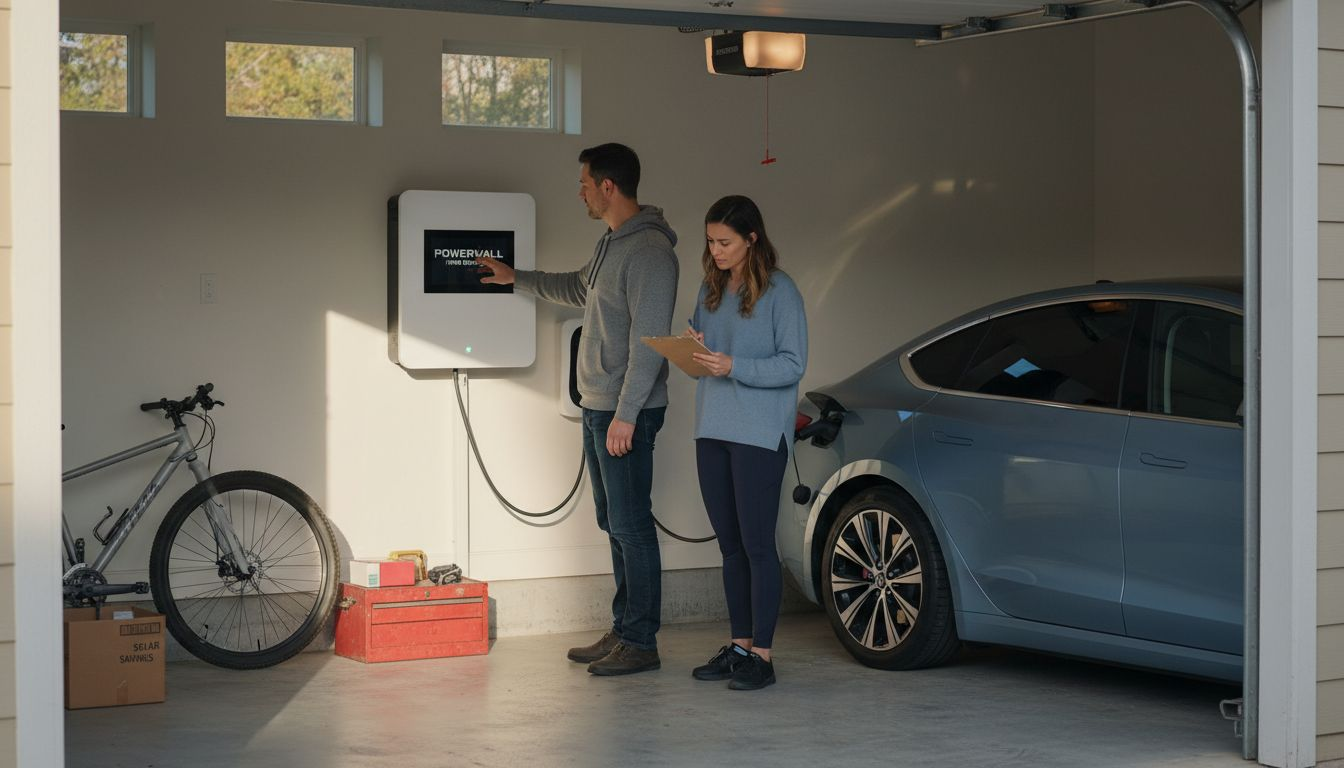
Selecting the right home energy storage system can feel complex when you want both future-ready technology and true value for your household. Homeowners across Central Europe are recognizing the importance of matching storage with actual energy use, as precise evaluation of household energy consumption is considered the foundation of an efficient solution. This guide will help you make smart decisions by focusing on advanced options, key performance features, and practical steps that lead to real savings and greater control of your home’s power.
Table of Contents
Quick Summary
Main Insight | Description |
1. Conduct a thorough energy audit | Analyze your electricity bills to understand consumption patterns, peak demand times, and baseline needs to inform storage decisions. |
2. Evaluate advanced technology features | Assess battery chemistry, inverter compatibility, and smart management features to find the right system for your home. |
3. Compare costs and performance | Balance initial investments with long-term savings by evaluating various storage technologies and their efficiency ratings. |
4. Integrate with energy management systems | Use smart technologies for real-time monitoring and control, improving efficiency and cost savings across your energy usage. |
5. Verify system performance regularly | Implement a monitoring strategy to track efficiency, savings, and system health, ensuring your investment remains optimal over time. |
Step 1: Assess Your Home’s Energy Needs
Understanding your home’s unique energy consumption is the critical first step in selecting an appropriate energy storage solution. By conducting a comprehensive energy audit, you’ll gain precise insights into your household’s electricity usage patterns and potential storage requirements.
To effectively assess your home’s energy needs, start by collecting detailed electricity consumption data. This involves examining your utility bills from the past 12 months to understand seasonal variations and peak energy demand periods. Detailed energy efficiency analysis recommends tracking these key metrics:
Total monthly electricity consumption
Peak daily energy usage times
Seasonal variations in electricity demand
Baseline power requirements for essential appliances
Consider using a professional energy monitoring device or working with an energy consultant who can provide advanced insights into your consumption patterns. These tools can help you:
Identify energy-intensive appliances
Understand your home’s baseline and peak power needs
Calculate potential storage capacity requirements
Estimate potential cost savings from energy storage
Your energy storage system should match your specific household consumption, not a generic one-size-fits-all approach.
Additionally, factor in future energy needs by considering potential changes like electric vehicle charging, home expansions, or the addition of energy-intensive appliances. This forward-looking approach ensures your storage solution remains relevant and efficient.

Pro tip: Keep a detailed log of your energy consumption for at least three months to capture the most accurate representation of your household’s energy dynamics.
Step 2: Identify Key Technology Features
Selecting the right energy storage technology requires a comprehensive understanding of the advanced features that distinguish modern systems. Your goal is to evaluate the technical capabilities that will provide the most efficient and reliable solution for your home’s unique energy needs.
Advanced energy storage technologies offer homeowners a range of sophisticated features to consider. Key technological aspects you should examine include:
Battery chemistry determining system longevity and performance
Inverter compatibility for seamless renewable energy integration
Modular design allowing future system expansion
Smart energy management capabilities
Grid interaction and load balancing features
Pay special attention to critical technological parameters that impact overall system effectiveness:
Energy conversion efficiency
Response time during power fluctuations
Temperature and environmental performance
Software integration capabilities
Technology selection is not just about current needs but anticipating future energy management requirements.
The European energy landscape increasingly values systems with flexible grid integration that can adapt to dynamic electricity markets. Look for technologies that offer:
Real-time energy optimization
Predictive maintenance capabilities
Remote monitoring and control
Scalable architecture
Pro tip: Request detailed technical specifications and performance data sheets from manufacturers to conduct a comprehensive technology comparison.
Step 3: Compare Storage Options and Costs
Navigating the complex landscape of energy storage solutions requires a strategic approach to comparing different technologies, their performance metrics, and associated financial investments. Your objective is to conduct a comprehensive evaluation that balances upfront costs with long-term energy savings and system capabilities.
Detailed cost-efficiency analysis reveals critical considerations for homeowners when comparing storage options:
Lithium-ion batteries: High energy density, moderate cost
Lead-acid batteries: Lower initial investment, shorter lifespan
Graphene supercapacitors: Advanced performance, higher upfront cost
Thermal storage systems: Unique efficiency for specific applications
Hybrid solutions: Combining multiple storage technologies
When comparing options, evaluate these key financial and performance parameters:
Initial capital expenditure
Expected operational lifespan
Efficiency rating and energy conversion losses
Maintenance requirements and associated costs
Potential energy savings and return on investment
Your storage solution should be viewed as a long-term investment, not just an immediate purchase.
Consider additional factors that impact overall cost-effectiveness:
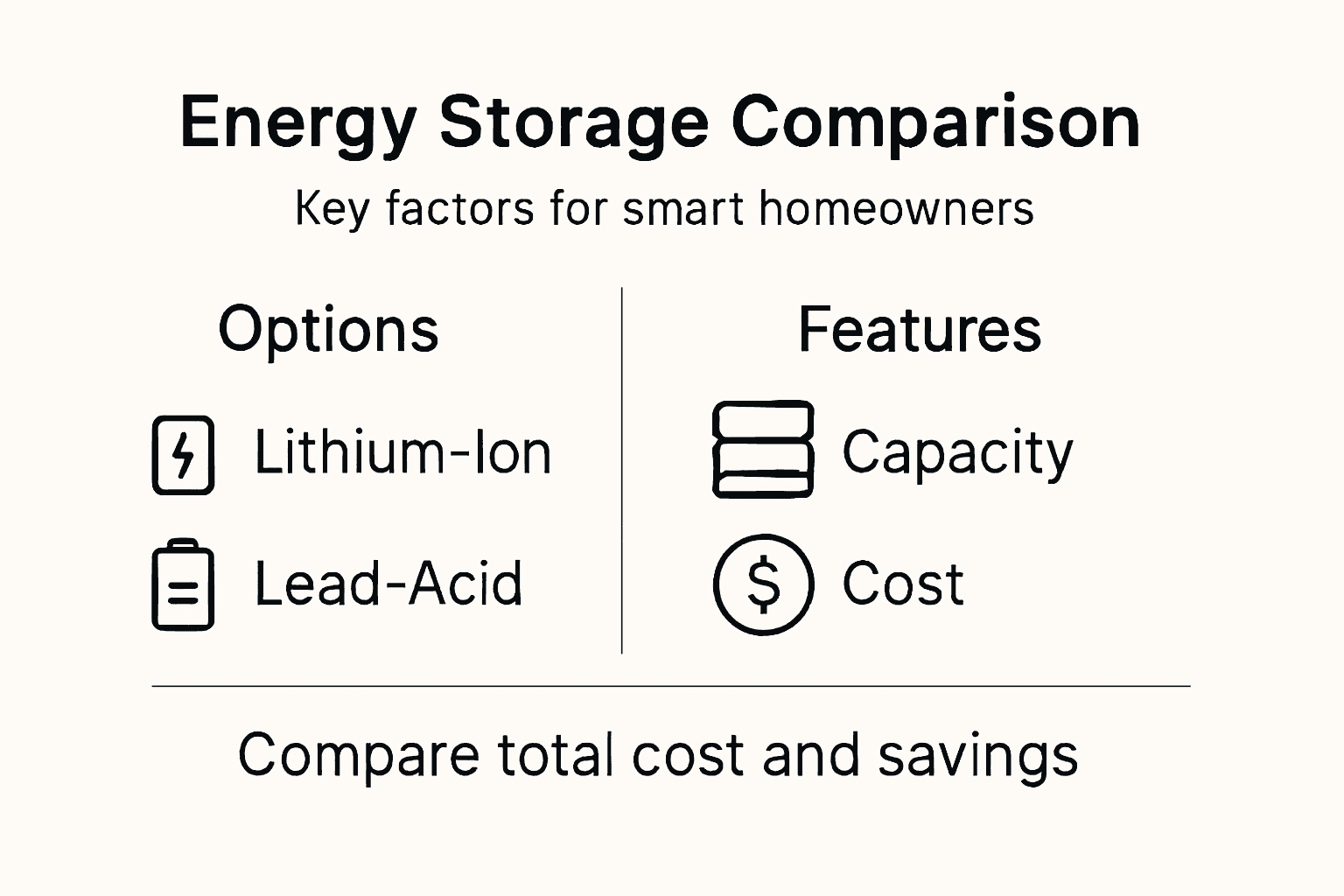
Here’s a comparison of common home energy storage technologies and their unique advantages:
Storage Type | Main Benefit | Typical Drawback |
Lithium-ion batteries | High energy density | Higher upfront cost |
Lead-acid batteries | Lower initial cost | Shorter lifespan |
Graphene supercapacitors | Rapid charge/discharge | Expensive and less common |
Thermal storage | Good for heating/cooling | Limited electric application |
Hybrid solutions | Versatile use cases | More complex management |
Manufacturer warranty terms
Scalability and future upgrade potential
Energy market electricity rate structures
Local incentives and tax credits
Grid interaction capabilities
Pro tip: Request comprehensive financial modeling that projects 10-year total cost of ownership, including potential energy savings and maintenance expenses.
Step 4: Integrate with Energy Management Systems
Successfully integrating your energy storage solution requires a sophisticated approach to managing and optimizing your home’s electricity ecosystem. Your goal is to create a seamless, intelligent system that maximizes energy efficiency, reduces costs, and provides unprecedented control over your power consumption.
Smart energy management technologies offer homeowners powerful tools for comprehensive energy control. Key integration strategies include:
Real-time monitoring of energy production and consumption
Automated charging and discharging schedules
Dynamic load balancing across different energy sources
Predictive energy optimization algorithms
Remote control through mobile applications
When selecting an energy management system, evaluate these critical integration capabilities:
Compatibility with existing home infrastructure
API and third-party system connectivity
Data visualization and reporting features
Machine learning adaptation capabilities
Cybersecurity and data protection standards
An effective energy management system transforms your storage solution from a passive device into an intelligent, responsive energy hub.
Consider these additional integration factors:
Summary of key integration features for smart home energy management systems:
Integration Feature | Purpose | Added Value |
Real-time monitoring | Live energy tracking | Immediate issue detection |
Automated scheduling | Timed charging/discharging | Maximizes cost savings |
Predictive optimization | Uses algorithms | Anticipates energy needs |
Remote control | Manage via mobile app | User-friendly convenience |
Inverter communication protocols
Solar PV system synchronization
Electric vehicle charging coordination
Grid service participation potential
Scalability for future technology upgrades
Pro tip: Request a comprehensive system demonstration that showcases real-time energy flow management and provides transparent performance metrics.
Step 5: Verify System Performance and Savings
Validating your energy storage system’s performance goes beyond initial installation. Your objective is to develop a comprehensive monitoring strategy that tracks real-world efficiency, financial returns, and long-term system health.
Performance verification techniques provide homeowners with critical methodologies for assessing storage system effectiveness. Key metrics to track include:
Energy conversion efficiency
Capacity retention rate
Cost savings percentage
Peak demand reduction
Carbon emissions offset
Implement a systematic verification process through these strategic steps:
Install comprehensive monitoring software
Track monthly energy production and consumption
Compare actual savings against projected estimates
Document system performance quarterly
Conduct annual comprehensive system assessment
Consistent monitoring transforms your energy storage from an investment into a measurable, optimizable asset.
Evaluate performance through multiple lenses:
Financial impact analysis
Technical system diagnostics
Energy consumption patterns
Grid interaction effectiveness
Predictive maintenance indicators
Pro tip: Create a dedicated digital dashboard that aggregates performance metrics, enabling quick and intuitive system health assessment.
Choose the Right Energy Storage with Confidence
Selecting the perfect energy storage solution can feel overwhelming when you face complex choices about battery chemistry, system efficiency, and integration capabilities. If you want to avoid costly mistakes and ensure your home’s energy storage matches your unique consumption patterns and future needs you need a partner who understands these challenges. Belinus offers cutting-edge solutions such as the Energy Wall G1 graphene supercapacitor and smart Solis inverters that integrate seamlessly with intelligent Energy Management Systems designed precisely for homeowners like you.
Explore how our advanced residential energy storage products empower you with real-time energy optimization, scalable modular designs, and detailed 25-year financial modeling tools to maximize savings and sustainability. Take control of your home power ecosystem now by visiting Belinus and discover how our comprehensive solar PV, battery storage, and EV charging solutions can turn your smart energy management vision into reality. Learn more about our Energy Wall G1 battery and Solis inverters today and make the confident choice to future-proof your home energy system.
Frequently Asked Questions
How do I assess my home’s energy needs for storage?
Start by examining your utility bills from the past 12 months to understand your electricity consumption patterns. Track total monthly usage, peak times, and essential appliances’ requirements to get a clear picture of your energy needs.
What key technology features should I look for in energy storage solutions?
Evaluate battery chemistry, inverter compatibility, and smart energy management capabilities to ensure the system meets your future energy demands. Focus on features like energy conversion efficiency and modular design for potential scalability.
How can I compare different energy storage options and their costs?
Assess initial costs against long-term savings by reviewing efficiency ratings, maintenance needs, and operational lifespan for different storage technologies. Use a cost-benefit analysis to determine which option delivers the best overall value for your household.
What are the best practices for integrating an energy storage system with my home?
Consider systems that allow real-time monitoring, automated charging, and control via mobile applications. Ensure compatibility with existing infrastructure to streamline the integration process and enhance energy efficiency.
How do I verify the performance and savings of my energy storage system?
Implement a systematic monitoring strategy, tracking key metrics like energy conversion efficiency and cost savings percentage. Regularly compare actual performance against projections to evaluate the effectiveness of your energy storage solution.
What should I include in my energy consumption log for accurate assessment?
Log your total energy consumption, peak usage times, and variations throughout different seasons for at least three months. This data will provide a comprehensive view of your energy dynamics to better inform your storage solution decisions.
Recommended
Comments