Battery system safety guide: home & business best practices
TL;DR:
Battery systems pose fire, chemical, electrical, and security risks if improperly installed or maintained.
Compliance with regional safety guidelines and thorough documentation are essential for insurance and safety.
Regular inspections, proper installation, and professional support reduce risks and ensure long-term system safety.
Battery systems are becoming a fixture in Benelux homes and businesses, but the risks that come with them are growing just as fast. Fires, chemical leaks, and electrical faults are not hypothetical scenarios. They happen when systems are poorly installed, incorrectly maintained, or placed in the wrong environment. At the same time, EU safety harmonization is ongoing and insurers are already raising the bar before legislation catches up. This guide walks you through the real risks, the tools you need, the correct setup process, and the ongoing checks that keep your system safe and your coverage intact.
Table of Contents
Key Takeaways
Point | Details |
Know the regulations | Benelux battery system requirements are quickly evolving—staying informed keeps you safe and compliant. |
Preparation matters | A thorough checklist before installation prevents costly mistakes and boosts safety from the start. |
Follow best practices | Proper site setup, secure wiring, and ongoing maintenance are essential for safe battery systems. |
Proactive beats reactive | Exceeding minimum standards protects your investment and ensures insurance coverage. |
Understanding battery system risks and regulations
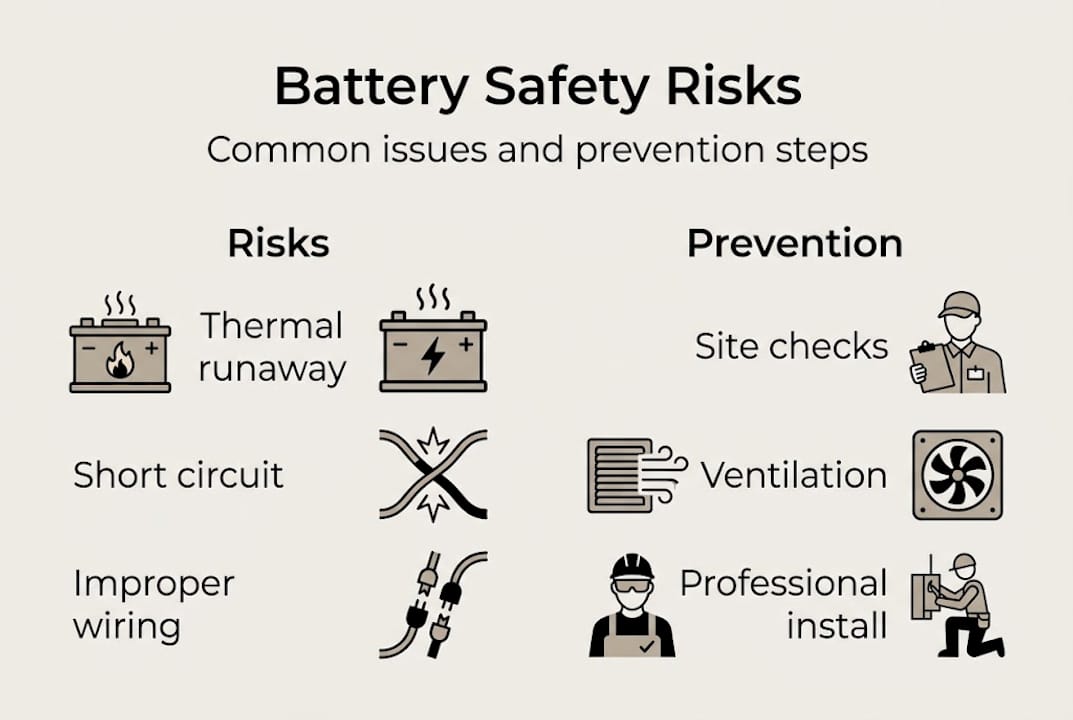
Battery energy storage systems pack a significant amount of energy into a relatively small space. That is what makes them useful. It is also what makes them dangerous when something goes wrong. The four main hazard categories you need to understand are fire risk from thermal runaway, chemical leaks from damaged cells, electrical hazards during installation or maintenance, and unauthorized access to live systems.
Thermal runaway is the most serious concern. It occurs when a battery cell overheats, triggering a chain reaction that can spread to neighboring cells and cause a fire that is extremely difficult to extinguish. This is not a rare edge case. It is a documented failure mode across lithium-based battery chemistries, including LFP (lithium iron phosphate), which is widely considered the safest option.
In the Netherlands, the PGS 37 guideline sets the national standard for battery storage safety. In Belgium, the AREI (Algemeen Reglement op de Elektrische Installaties) governs electrical installation requirements. Both frameworks address physical placement, ventilation, fire suppression, and emergency procedures. By 2027, new EU standards will be implemented but national variations will remain in place during the transition period.
Here is a quick breakdown of the primary risk categories and their mitigation measures:
Risk category | Primary cause | Key mitigation |
Fire and thermal runaway | Cell overheating, overcharging | Fire-rated enclosure, BMS monitoring |
Chemical exposure | Cell damage, leaks | Proper ventilation, protective gear |
Electrical shock | Improper wiring, live access | Insulated tools, lockout procedures |
Unauthorized access | Unsecured installation area | Access control, warning signage |
Why do insurers care before the law requires it? Because claims from battery incidents are rising. Insurers have started requiring documented compliance with battery safety regulations as a condition of coverage, even when those regulations are technically advisory. A policy exclusion buried in the fine print can leave you fully exposed after an incident.
“Treating safety guidelines as optional is a financial risk, not just a physical one. Insurers and local authorities increasingly treat best-practice compliance as a baseline expectation, regardless of whether it is written into law yet.”
What you need: Tools and prerequisites for safe battery integration
Many installation risks are preventable through preparation and checklists. Before any hardware arrives on site, you need to confirm three things: the physical environment is suitable, the electrical infrastructure can support the system, and you have the right safety equipment on hand.

Site requirements are the foundation. Your installation location needs adequate ventilation to prevent heat and gas buildup, fire-resistant walls or enclosures rated to at least 60 minutes, physical access control to keep unauthorized people away from live systems, and a clear path for emergency responders if something goes wrong.
Essential tools and materials for a compliant setup include:
Insulated gloves rated for high voltage work
A calibrated voltage tester to verify de-energized circuits before touching them
Emergency shutoff switch, clearly labeled and accessible
Fire-rated battery cabinet or enclosure
Warning signage in the language(s) of your region
Surge protection device at the point of connection
A battery management system (BMS) with real-time monitoring capability
Here is a comparison of installation environments to help you choose the right location:
Location type | Ventilation | Fire resistance | Access control | Recommended |
Dedicated utility room | High | Built-in | Lockable door | Yes |
Garage (attached) | Medium | Variable | Moderate | Conditional |
Basement | Low | Variable | Moderate | Not ideal |
Outdoor enclosure | High | Rated cabinet needed | Lockable | Yes, with proper cabinet |
The installation preparation steps you take before the first cable is connected are the ones that prevent the most serious incidents.
Pro Tip: Before finalizing your installation location, contact your insurer and describe the planned setup in detail. Some insurers have specific requirements around fire suppression or minimum distances from living spaces. Getting pre-approval saves you from a costly relocation after the fact.
Step-by-step battery system safety setup
Correct installation minimizes long-term system failures and fire risk. Here is the sequence that matters:
Site inspection. Verify ventilation, fire resistance, and clearance distances against PGS 37 or AREI requirements before any equipment is moved in.
Secure mounting. Fix the battery unit to a structural wall or floor mount using manufacturer-specified hardware. A loose battery is a physical hazard during seismic events and a warranty issue.
Electrical connection. Use properly rated cables, connect through a dedicated circuit breaker, and install surge protection at the point of entry. Never share a circuit with other high-draw appliances.
BMS configuration. Set charge and discharge limits within the manufacturer’s recommended range. For most LFP systems, this means keeping state of charge between 10% and 90% for daily cycling.
Solar and EMS integration. If you are connecting to a solar PV system, configure the energy management system to prioritize self-consumption and avoid overcharging during peak generation hours. An efficient battery storage setup accounts for seasonal variation in solar output.
Initial system test. Run a full charge and discharge cycle while monitoring temperature, voltage, and system alerts. Confirm that all safety shutoffs trigger correctly at threshold values.
Documentation. Record the installation date, configuration settings, and inspection results. This documentation is what your insurer will ask for if you ever file a claim.
Following storage best practices from day one is far less expensive than correcting a non-compliant installation after the fact.
Pro Tip: Take photos of every stage of the installation, especially wiring connections and mounting hardware. A visual record protects you during insurance claims and simplifies future maintenance.
Safety stat worth knowing: Properly installed and commissioned battery systems with active BMS monitoring have a significantly lower incident rate than systems installed without professional commissioning. The difference is not marginal. It is the gap between a system that works for 15 years and one that fails in year two.
Ongoing safety checks and common pitfalls to avoid
Regular checks and proper upkeep prevent major failures. After installation, your safety responsibility does not end. It shifts from setup to monitoring.
Monthly checks you should perform:
Review the BMS dashboard for any error codes or unusual patterns
Check the physical enclosure for signs of heat, corrosion, or moisture
Confirm that ventilation openings are clear and unobstructed
Verify that warning signage is still visible and legible
Note any changes in charge or discharge behavior compared to baseline
Annual professional inspection should cover:
Inspection item | Why it matters |
Torque check on all electrical connections | Loose connections cause resistance heating |
Firmware and BMS software update | Patches critical safety vulnerabilities |
Capacity test | Identifies cell degradation before it becomes a hazard |
Fire suppression check | Ensures suppression systems are functional |
Documentation review | Keeps compliance records current |
Common pitfalls that cause incidents:
Overloading the system beyond its rated continuous discharge capacity
Blocking ventilation openings with stored items
Skipping firmware updates because the system “seems fine”
Ignoring minor alerts on the assumption they are not serious
Failing to notify your insurer after any system modification
“The most dangerous moment in battery ownership is not the first year. It is year three or four, when familiarity breeds complacency and routine checks start getting skipped.”
End-of-life handling is also a legal and safety obligation. Do not dispose of battery modules in general waste. Use certified battery recycling tips and facilities to manage hazardous components correctly. In the Benelux region, several certified collection points exist for residential and commercial battery systems.
Follow the maintenance best practices outlined by your system manufacturer and supplement them with the checks above.
The overlooked realities of battery safety in Benelux
Most homeowners and business operators assume that if they followed the installer’s checklist, they are covered. That assumption is costing people real money. We have seen cases where insurers denied claims not because the system was installed incorrectly, but because the owner could not prove it was installed correctly. No documentation. No photos. No signed commissioning report.
There is also a widespread misreading of what “optional” means in the context of guidelines like PGS 37. Even guidelines that are not yet legally binding are routinely referenced by insurers and local fire authorities as the standard of care. If an incident occurs and your setup did not follow those guidelines, the fact that they were technically advisory provides zero protection.
The practical lesson from real-world safety lessons in the Benelux market is straightforward: treat best practices as the default, not the ceiling. Exceed the minimum. Document everything. And revisit your setup every time you make a change to your energy system, because a modification that seems minor can shift your compliance status in ways that are not immediately obvious.
Pro Tip: Set a calendar reminder every six months to review your battery system documentation and confirm your insurer still has the current configuration on file.
Start your safe battery journey with Belinus
If you are serious about battery safety, the right partner makes a measurable difference. Belinus designs and delivers Benelux battery system solutions built for compliance from the ground up, with integrated energy management that monitors your system in real time and flags issues before they become incidents.

Whether you are a homeowner looking at residential storage or a business evaluating commercial-scale options, our team can walk you through a site assessment, system design, and commissioning process that meets current Benelux requirements and positions you well ahead of the 2027 EU harmonization deadline. Reach out for an expert consultation and get a setup that protects your property, your investment, and your insurance coverage from day one.
Frequently asked questions
Are EU battery safety guidelines mandatory for Benelux homes and businesses?
Not always yet, but most insurers and authorities now require compliance as a practical condition of coverage and approval, so check your national rules for current obligations.
What is the safest location for a home battery system?
Install in a well-ventilated, fire-rated area away from daily living spaces and electrical hazards, following PGS 37 or AREI guidelines for your country.
How often should I check or maintain my battery system?
Perform monthly visual and dashboard checks yourself, and schedule an annual professional inspection to cover electrical connections and firmware updates.
What are the signs of a battery safety issue?
Warning signs include excess heat around the enclosure, unusual smells, unexpected drops in capacity, error codes on the BMS dashboard, or visible physical damage to the unit.
How should I dispose of an end-of-life battery system?
Use certified battery recycling centers to safely handle hazardous components and meet the legal disposal requirements in your region.
Recommended
Comments